
Every job system in this category promises you will not enter the same information twice. It is a fair promise and it is almost always stated too vaguely to act on.
The version worth having is mechanical. Which fields carry from one stage to the next. Which ones do not. And where a person still has to make a decision, because those are the points where a business either builds a habit or develops a leak.
This article is that answer for Systemise. It is deliberately about mechanics rather than margin. What all of this is for is covered in the article on protecting job margins.
Three records, not one record with three names
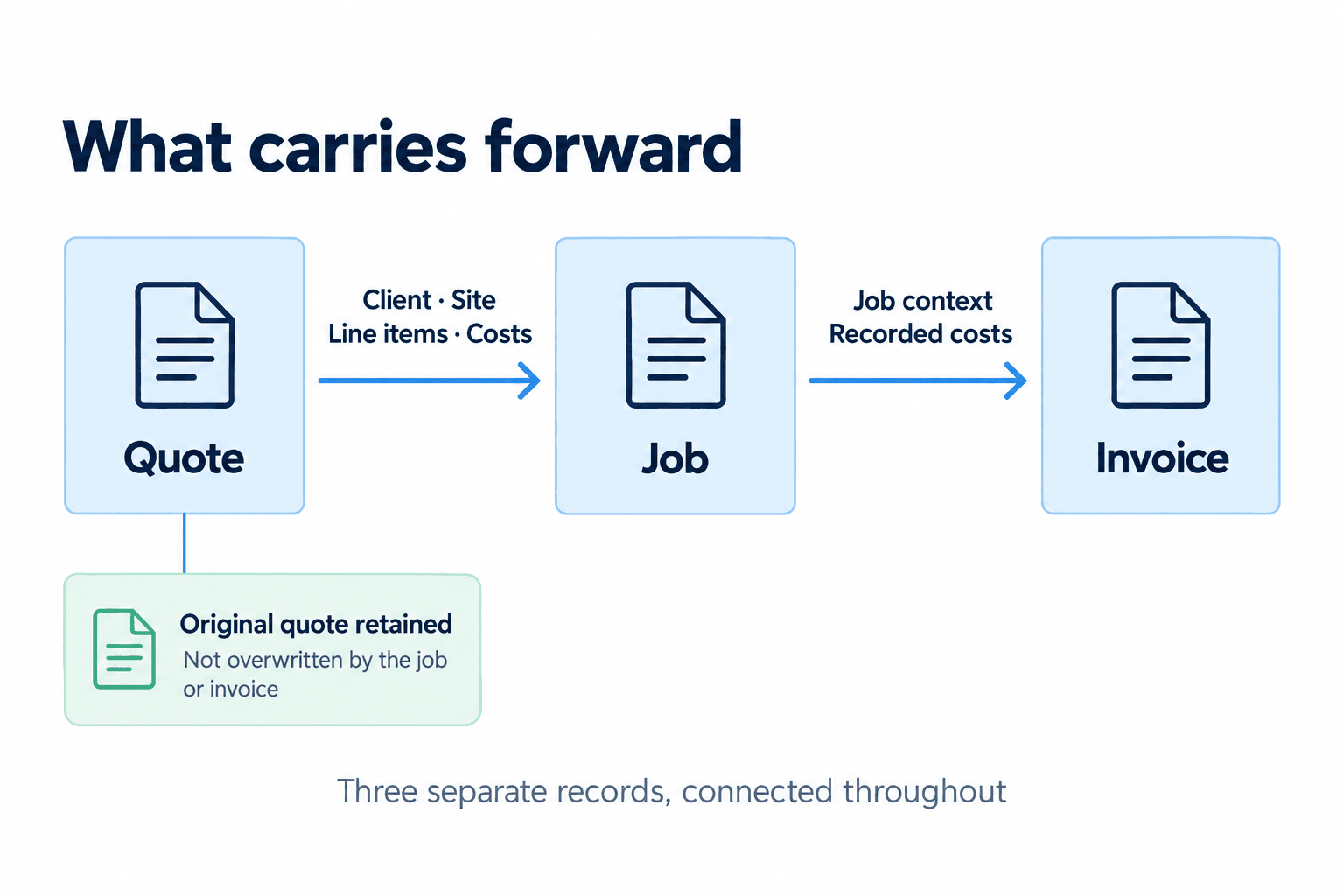
A quote, a job and an invoice are separate records that reference each other. That sounds like a technicality and it is the thing that determines what is possible later.
If they were one record changing state, the quote would be overwritten by what actually happened, and comparing what you priced against what you delivered would be impossible. You would only ever have the latest version of the truth.
Because they are separate, the quote stays as it was written. That is what makes quoted-against-actual a real comparison rather than an assertion.
Quote to job
When a quote is accepted and becomes a job, the job carries the client, the site, the line items and the costs from the quote.
What that saves you is the re-keying, and more importantly the transcription errors that come with re-keying. A quantity typed correctly into the quote and incorrectly into the job is not caught by anything, and it surfaces two months later as a job that lost money for no visible reason.
The quote context is retained against the job, which is what lets the quoted cost be compared with the material and labour cost that gets recorded as the work happens.
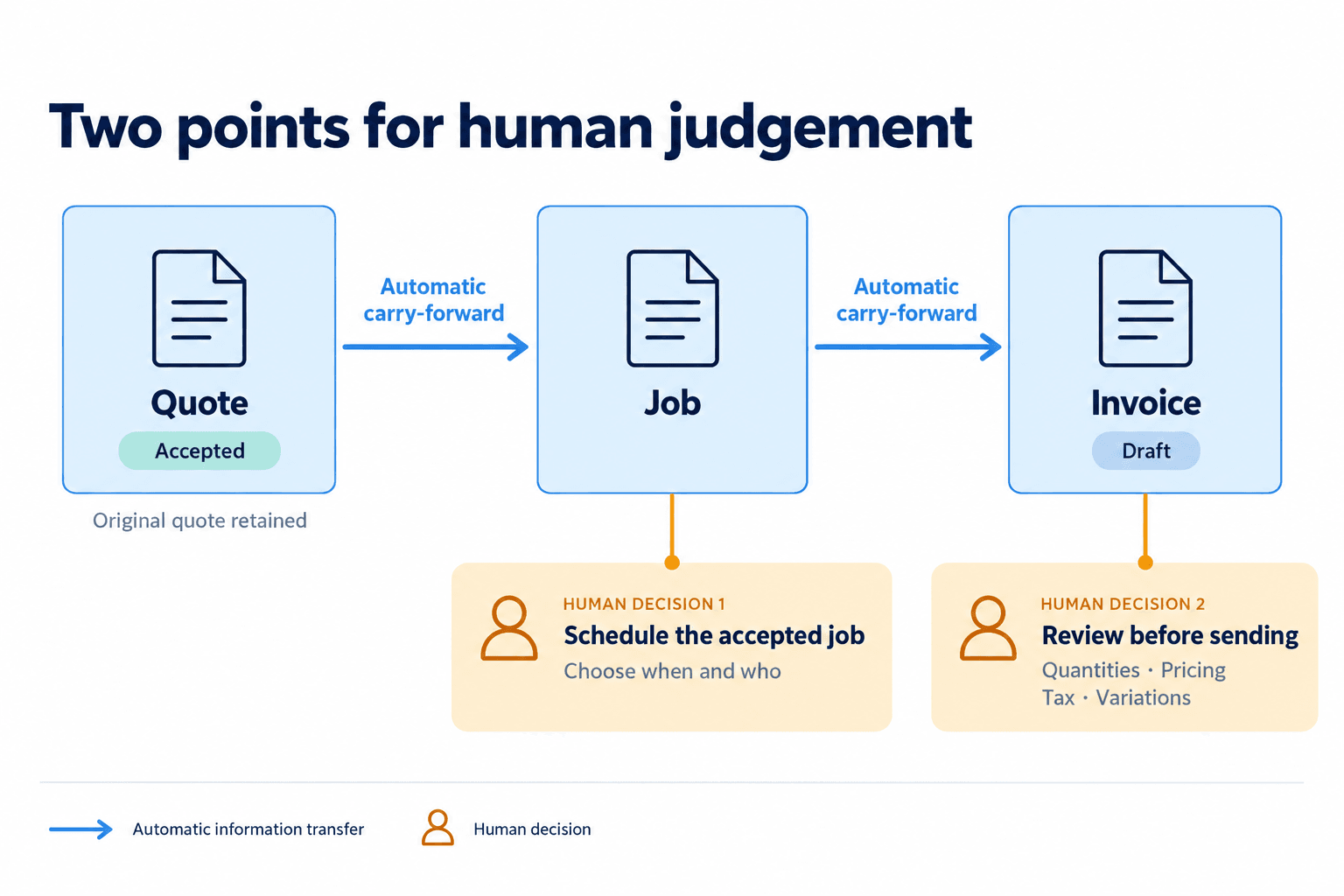
What does not carry across is the schedule. An accepted quote does not know when the work will happen or who will do it. Somebody has to put it on the board. That is the first genuine decision point, and jobs sitting accepted-but-unscheduled are the most common gap in any trade business.
What happens while the job runs
This is the stage that determines whether the invoice is right, and it is entirely about what gets recorded.
Hours go on against the job, from the browser or from the field. Materials and other costs go on, including receipts photographed at the merchant and costed to the job. Variations and extra work are recorded against the job rather than remembered.
That last one is the leak most businesses have. Extra work agreed verbally on site, done, and never written down anywhere that reaches the invoice. It is not a software problem, but a system that makes it easy to record on the spot is the difference between capturing it and not.
Job to invoice
An invoice can be created from the job or from the accepted quote, drawing the relevant client and line-item context forward rather than starting from an empty form.
Then you check it, and this is the second genuine decision point. Before it goes out, someone has to confirm the quantities, the pricing, the tax treatment, and whether the variations are all on there. The invoice should reflect the work actually completed, which is not always identical to what was quoted, and the system cannot know which differences were deliberate.
This is why the promise is never quite "the invoice writes itself". It is "you are checking a draft rather than building one from memory", which is a smaller claim and an honest one.
Where the money side sits
Invoices track what has been paid and what is outstanding.
On the accounting side, be precise about the boundary, because this is where assumptions cost people a month. What moves between Systemise and Xero is contacts, suppliers, an optional product push, and account-code mapping. Sales invoices and payments are covered in a separate article on the Xero connection, and it is worth reading before you decide where your invoicing will live.
The comparison this makes possible
Because the quote is retained and the actuals accumulate against the job, the job's financial view can show quoted against recorded, and Report Studio can build the same comparison across many jobs.
Two cautions on that, both worth stating.
The comparison is only as good as what was recorded. A job with half its hours missing looks more profitable than it was, and this is the single most common way job costing misleads people.
And cost and margin are visible only to users whose permissions allow it, so this view belongs to whoever is meant to have it rather than everyone who can open the job.
Where a business still has to intervene
Putting all of it together, four things stay human.
- Scheduling the accepted work. Nothing books itself.
- Recording variations as they are agreed. The system makes it easy and cannot make it happen.
- Reviewing the invoice before it is sent. Quantities, pricing, tax, variations.
- Deciding where invoicing lives if you use Xero, and then being consistent about it.
Everything else on the path from quote to payment is carried forward for you. Those four are the ones to build a habit around.
What this does not claim
No time saving, no reduction in errors, no percentage of anything. This is a description of what carries and what does not.
It also does not claim the invoice needs no review. It explicitly says the opposite, twice, because a system that encouraged you to send an unchecked invoice would be worse than one that made you build it by hand.
Where to look next
Quoting, Jobs and scheduling and Invoicing and payments cover each stage. The margin argument is in the article on protecting job margins when costs keep moving. The labour half of job cost is in the article on recording hours, and the materials half is in the article on capturing receipts.
If you want to sanity-check this against your own process, take one recently invoiced job and count how many times somebody typed the same information. In most businesses the answer is three, and the second and third are where the errors live.